Should you train hard today?
Every lifter knows the feeling: the program says squats, but your body says otherwise. Push through anyway and the session is junk — or worse, you get hurt. Back off when you didn't need to and you leave progress on the table. The real question isn't what to train. It's how hard, today.
Why a fixed program can't answer that
A traditional plan assumes every Monday is the same Monday. It isn't. Sleep, stress, and accumulated fatigue change what your body can productively absorb — sometimes by a lot. Recovery data can help fill that gap.
What HRV actually tells you
Heart-rate variability — the small variation in time between heartbeats — reflects how your nervous system is balancing stress and recovery. The key detail most apps get wrong: your absolute HRV number is nearly meaningless. A 40 ms HRV is low for one person and excellent for another. What matters is how today compares to your own recent baseline.
That's how Fit4i uses it. The app maintains a rolling personal baseline of your HRV and compares each morning against it. A meaningful dip is a signal — not a verdict — that today may not be the day to push.
One signal is never enough
HRV is noisy. A late meal, a glass of wine or a stressful evening can move it. So Fit4i never decides from HRV alone — it weighs several signals together:
- HRV against your personal rolling baseline
- Resting heart rate against your 30-day norm — a sustained elevation often precedes feeling run-down
- Sleep — duration and quality
- Blood oxygen overnight
- Recent training load — consecutive days without rest
- How you say you feel — a quick subjective check-in
From data to an adjusted session
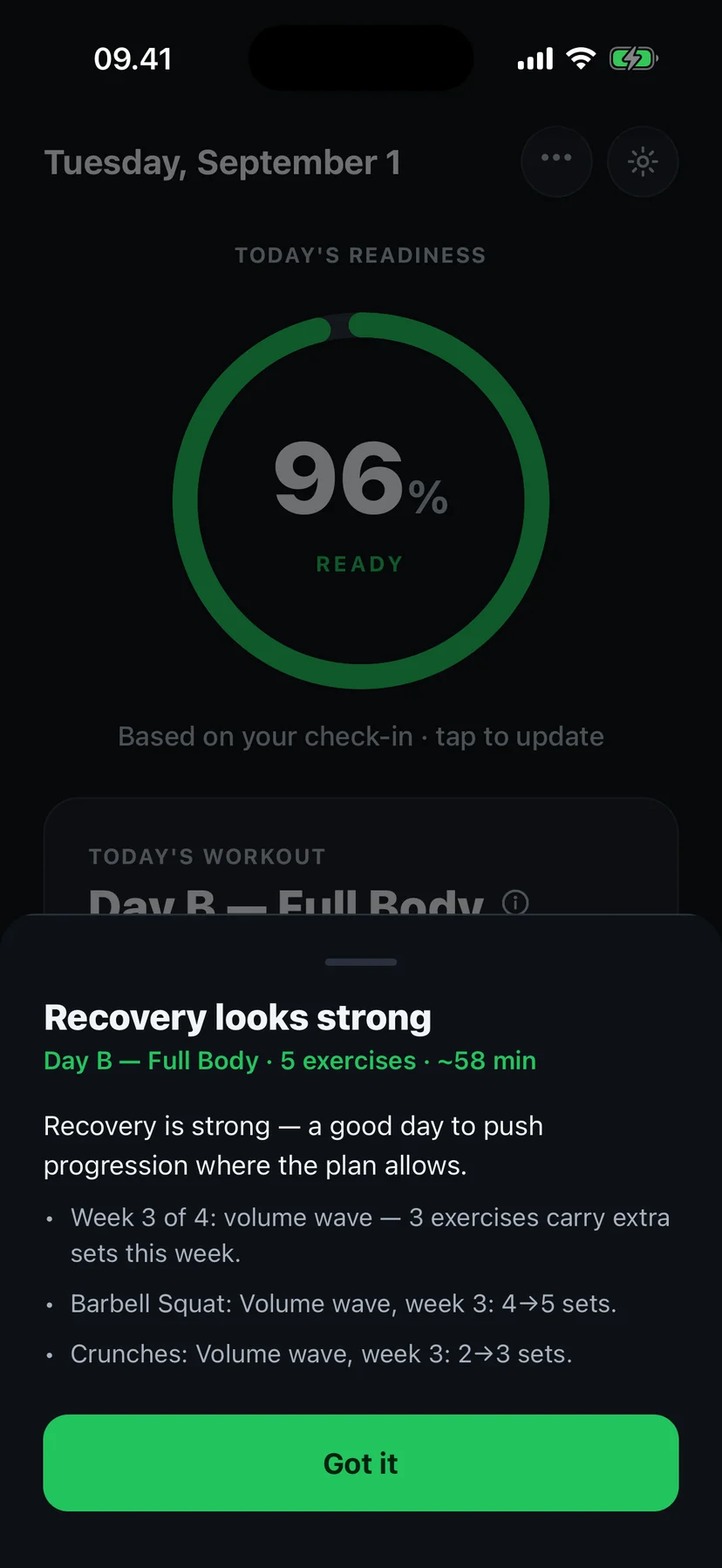
The result is one clear readiness verdict — Ready, Balanced or Recover— and a concrete change to today's plan:
- Ready— the full session as programmed. If you've earned a progression, weights move up.
- Balanced— the session stays, but volume is trimmed by roughly a quarter. You still train; you just don't dig a deeper hole.
- Recover — an easy day. The plan backs off so tomorrow can be productive.
These are training recommendations, not medical assessments — and you always have the final say. The adjustment happens inside your actual program (which handles progressive overload, volume waves and planned deloads), so an easy day never derails the bigger plan. A poor-recovery day — from your sensor or your check-in — eases the session for everyone. Tuning the in-between days and early deloads are part of Fit4i Pro.
No wearable? Still works.
If you don't wear a watch or band, a 10-second morning check-in — how you slept, how you feel — feeds the same engine. Honest inputs give honest recommendations. And if you tell the app you feel unwell, it eases the day on any plan.
Frequently asked questions
What does HRV tell you about recovery?
Heart-rate variability reflects how your nervous system is balancing stress and recovery — roughly, how ready your body is to absorb hard training. It's a useful signal, but on its own it doesn't tell the whole story of how you'll perform today.
Should one low HRV reading change a workout?
Not by itself. HRV is noisy — a late meal, alcohol or a stressful evening can move it. Fit4i looks for a meaningful dip against your own baseline, combined with sleep, resting heart rate and how you say you feel, before adjusting anything.
How does Fit4i compare HRV with a personal baseline?
Fit4i keeps a rolling personal baseline of your HRV, updated as you sync data. Each morning's reading is compared against that baseline — not a population average — since a healthy HRV for one person can be a low one for another.
What happens when readiness is low?
The plan backs off: intensity or volume is reduced for the day, or the session becomes a recovery-focused one. Your program isn't discarded — the adjustment happens inside your existing plan, so tomorrow can pick back up on track.
Can Fit4i work without an Apple Watch?
Yes. Fit4i reads any data written to Apple Health, so most wearables work, and Polar devices connect directly. With no wearable at all, a short morning check-in — how you slept, how you feel — drives the same adjustment logic.
Is readiness a medical assessment?
No. Fit4i's readiness score is training guidance, not a diagnosis or medical assessment. It does not detect or treat any condition. If something feels wrong beyond normal training fatigue, talk to a doctor rather than relying on the app.
Stop guessing. Let your recovery set the dial.
Or read more about how Fit4i reads Apple Watch and Apple Health data.