Should I train with low HRV?
Published July 16, 2026 · Updated August 29, 2026 · Fit4i Editorial Team
Fit4i creates evidence-informed training and recovery content based on publicly available research and established strength-training principles.
You open your recovery app, see a heart-rate variability number that's lower than usual, and immediately wonder whether today's workout is a mistake. The honest answer: a single low reading, by itself, usually isn't enough to decide anything.
What “low” actually means
Heart-rate variability (HRV) is highly individual — a number that would be alarmingly low for one person is a normal Tuesday for another. Research on HRV-guided training consistently emphasizes comparing today's reading against your own rolling baseline, built from one to two weeks of your own data, rather than against a generic target or someone else's number.
That also means a single day's reading is noisy. Sleep timing, alcohol, a late meal, heat, or even how well the sensor made contact can move HRV without reflecting a real change in recovery.
When it's worth paying attention
HRV becomes more informative when it's part of a trend, not a single data point. Sports-science reviews of HRV-guided training describe a meaningful signal as a sustained drop against your baseline, especially when it shows up alongside other signs:
- Resting heart rate trending upward over several days
- Shorter or more disrupted sleep than usual
- Elevated perceived effort for the same training load
- Several consecutive hard sessions without a rest day
One low reading with everything else normal is weak evidence. A low reading combined with two or three of the signals above is a much stronger reason to ease off.
A simple way to decide
You don't need an app to apply this. Before a session, ask:
- Is this reading meaningfully below my own normal, not just slightly different?
- Does how I actually feel agree with the number, or contradict it?
- Have I had at least one full rest day in the last several?
If the answers point the same direction — data and how you feel both say “off day” — that's a reasonable case for trimming volume or intensity rather than pushing a personal best. If they disagree, or it's just one number out of place, training as planned is usually fine.
Where an app like Fit4i fits in
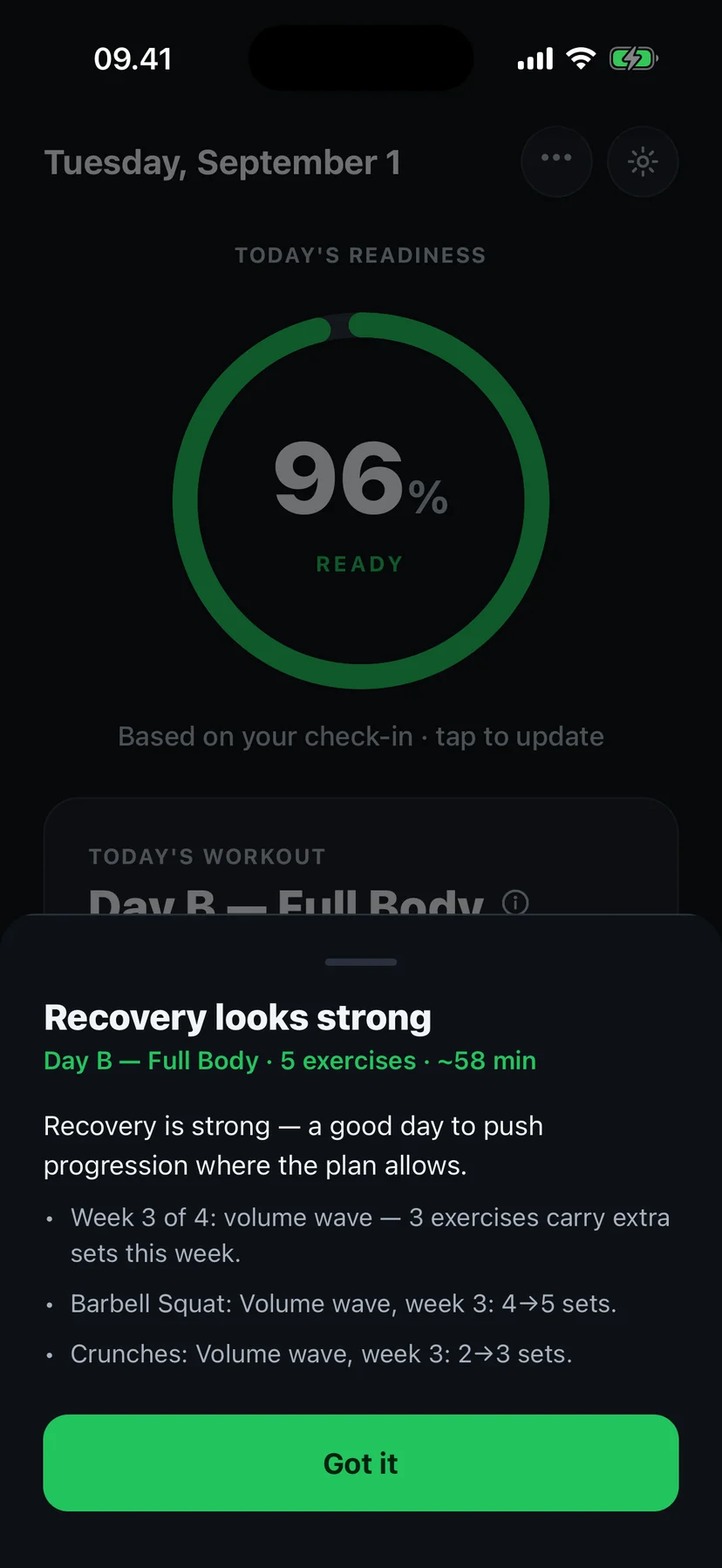
This is exactly the calculation Fit4i's readiness feature automates: it compares HRV against your personal baseline, weighs it against sleep, resting heart rate and recent training load, and turns the result into a concrete adjustment to that day's session — rather than leaving you to eyeball a number in isolation.
Sources & methodology
Guides are written against publicly available research and established strength-training principles, and reviewed for accuracy against how Fit4i actually works before publishing. The sources below informed this article:
Related guides
HRV
HRV vs Resting Heart Rate for Workout Recovery
Two related but different recovery signals, what each is better at catching, and why looking at both beats picking one.
Apple Watch & Health Data
How to Use Apple Watch Data for Workout Readiness
What Apple Watch actually measures that's useful for training decisions, and how to read the trends instead of a single day's number.
Recovery
How to Adjust a Workout When Recovery Is Low
Practical ways to scale a session down instead of skipping it entirely — and how to tell the difference between tired and unwell.
Let Fit4i read your HRV trend for you.